
Éra N-Fix:
Atmospheric Nitrogen Fixation / Antagonist Activity
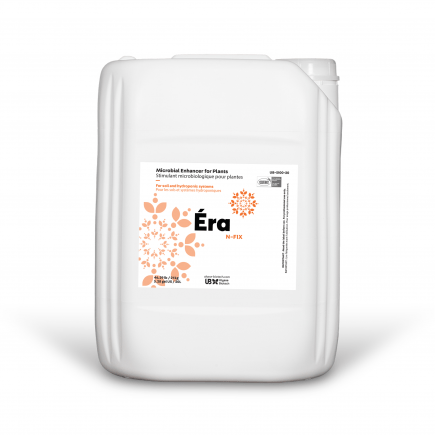
Éra N-Fix is a microbial product designed to fix atmospheric nitrogen. It delivers a continuous nitrogen supply throughout the plant's growth cycle. It is formulated from two Paenibacillus polymyxa strains and one Bacillus velezensis strain. It promotes vigorous root development. It enriches the rhizosphere microbiome. It also exerts broad-spectrum antagonistic activity against plant pathogens.

Who It's

It's For Field and greenhouse crops, flowering plants, all growing media and soil types. Ideal as a complement to Éra Boost Pro from transplant onward.

Key Benefits

√  Atmospheric nitrogen fixation for continuous, natural nitrogen supply
√  Vigorous root development from establishment
√  Broad-spectrum antagonist activity against plant pathogens
√  Enzymatic enrichment of the rhizosphere
√  Reduced dependence on nitrogen fertilizers

Mode of Action

Two bacterial strains present in Éra N-Fix fix atmospheric nitrogen (N₂) via the nitrogenase enzyme complex, encoded by the nifH gene. Nitrogen is converted into ammonium (NH₄⁺) directly assimilable by the plant, reducing dependence on synthetic nitrogen fertilizers.

The Bacillus velezensis strain synthesizes antifungal and antibacterial lipopeptides — iturin A, surfactin, and fengycin — that inhibit the development of foliar and root pathogens. This strain also induces systemic resistance (ISR) in the host plant. For their part, Paenibacillus polymyxa strains secrete natural enzymes and antibiotics that affect the growth of plant pests.

The three strains in Éra N-Fix work together to reshape the rhizosphere microbiome in favor of the plant. Auxin (IAA) production stimulates root elongation and branching, increasing nutrient absorption surface area. The Paenibacillus polymyxa strains also produce cytokinins that accelerate root cell division from the first days after transplanting. Together, these bacterial interactions create a structured rhizosphere environment, promoting a living and resilient growing medium.

Understanding PSB and PGPR mechanisms

Learn more

PSB and PGPR Bacteria: mechanisms and application

Phosphorus solubilization, auxins, siderophores : understanding what happens in the rhizosphere.

Read the article →

Guaranteed Minimum Microbial Concentration

Paenibacillus polymyxa U60 334 000 000 viable spores/g
Paenibacillus polymyxa U91 334 000 000 viable spores/g
Bacillus velezensis U147 334 000 000 viable spores/g

Application Table

CROP TYPE APPLICATION RATE FréquencY
High-yield crops (tomato, pepper, cucumber, strawberry). Seeding/grafting: 0.2 mL/L
Vegetative/productive: 0.4 mL/L
At planting, then every 2-3 weeks
Low-yield crops (lettuce, herbs). Seeding/grafting: 0.1 mL/L
Vegetative/productive: 0.2 mL/L
At planting, then every 2-3 weeks
Potted flowers. Seeding/grafting: 0.1 mL/L
Vegetative/productive: 0.2 mL/L
At planting, then every 2-3 weeks
Large horticultural crops (strawberry, blueberry, lettuce, broccoli). 1 to 2 L/ha or 0,4 to 0,8 L/acre Soil >15°C, every 4-5 weeks
Turf. 0,5 to 1 L/ha Soil >15°C, every 4-5 weeks
Seed inoculation. 85 mL/80,000 corn seeds
120 mL/120,000 wheat seeds
Adjust to 1,000,000 viable spores/seed

Certifications

✓  Approved for organic agriculture by Ecocert Canada.

✓  CFIA Registration No. 2024148S (Fertilizers Act).

Want to try Éra N-Fix?

Scroll to Top