
Éra Boost Pro:
Establish a Dominant Rhizosphere from Transplant
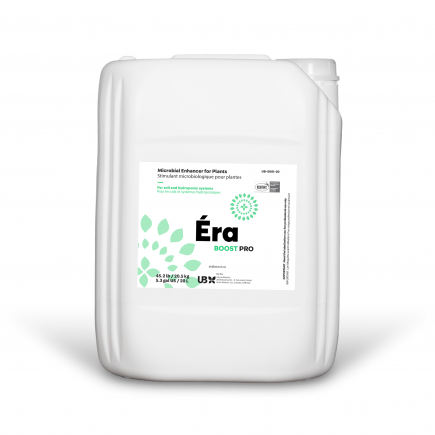
Éra Boost Pro is a consortium of six sporulating Bacillus strains. They are selected for their PGPR properties (Plant Growth-Promoting Rhizobacteria). The consortium rapidly colonizes the rhizosphere at transplant. It solubilizes phosphorus and stimulates root development. The plant absorbs nutrients efficiently within the first hours after establishment.

Who It's

For Greenhouse crops (tomato, cucumber, pepper, lettuce, herbs, strawberry, blueberry, raspberry and cranberry), field horticultural producers, large-scale crop producers, nurseries and plug plant producers.

Key Benefits

✓ Rapid rhizosphere colonization: spores germinate on contact with root exudate
✓ Inorganic phosphorus solubilization: releases fixed P in the substrate
✓ Organic phosphorus mineralization: conversion to assimilable P via phytase production
✓ Auxin production (IAA): stimulates root elongation and branching
✓ Siderophore production:  chelates ferrous iron in the soil
✓ Enzyme secretion:  proteases, cellulases and glucanases
✓ Fungal antagonism: direct competition against Pythium and Fusarium
✓ Sporulating formula: guaranteed stability 24 months without refrigeration (unopened container)

Mode of Action

Upon contact with root exudates, Bacillus spores germinate within 4 to 6 hours. The vegetative cells colonize the root surface and form a protective biofilm that occupies attachment sites before pathogens can establish.

The PSB strains secrete organic acids that dissolve inorganic phosphorus fixed in the substrate. Phytase production ensures the mineralization of organic phosphorus. IAA production stimulates root elongation and increases the absorption surface area.

Certain strains produce lipopeptides (iturin, surfactin, fengycin) that inhibit fungal spore germination at the root site. This antagonistic activity, combined with physical occupation of the niche, helps reduce the pressure of certain root diseases.

Understanding PSB and PGPR mechanisms

Learn more

PSB and PGPR Bacteria: mechanisms and application

Phosphorus solubilization, auxins, siderophores : understanding what happens in the rhizosphere.

Read the article →

Guaranteed Minimum Microbial Concentration

Bacillus licheniformis U35 67 000 000 viable spores/g
Priestia megaterium U48 67 000 000 viable spores/g
Priestia megaterium U49 67 000 000 viable spores/g
Bacillus velezensis U50 67 000 000 viable spores/g
Bacillus subtilis U128 67 000 000 viable spores/g
Bacillus subtilis U226 67 000 000 viable spores/g

Application Table

CROP TYPE APPLICATION RATE FREQUENCY
High-yield crops (tomato, pepper, cucumber). Seeding/transplant: 0.25 mL/L
Vegetative/flowering: 0.5 mL/L
At transplant, then every 2-3 weeks
Low-yield crops (lettuce, herbs). Seeding/transplant: 0.1 mL/L
Vegetative/flowering: 0.25 mL/L
At transplant, then every 4-5 weeks
Potted flowers. Seeding/transplant: 0.1 mL/L
Vegetative/flowering: 0.25 mL/L
At transplant (soil >15°C), then every 4-5 weeks
Large horticultural crops (strawberry, blueberry, lettuce, broccoli). 1 to 1.5 L/ha or  0.4 to 0.6 L/acre At transplant (soil >15°C), then every 4-5 weeks
Turf. 0.8 to 1.2 L/ha or  0.3 to 0.5 L/acre Soil >15°C, every 4-5 weeks

Certifications

✓  Approved for organic agriculture by ECOCERT CANADA.

✓  Registration No. 2018137S Fertilizers Act.

Publication

Yaghoubian I, Msimbira LA, Smith DL (2022). Cell-Free Supernatant of Bacillus Strains can Improve Seed Vigor Index of Corn (Zea mays L.) Under Salinity Stress. Front. Sustain. Food Syst. 6:857643. doi: 10.3389/fsufs.2022.857643

Want to try Éra Boost Pro?

Scroll to Top